.webp) Online
OnlineNot sure which channel fits your business?View all services →
Three inputs. Instant KPIs. No spreadsheets.Open a calculator →
Online98% of your website visitors are walking away without taking a single action, effectively leaving your acquisition budget on the table. When you're burning through ad spend with stagnant ROI, the question isn't how to get more traffic, but rather, what does a cro agency do to capture the value you'r...

98% of your website visitors are walking away without taking a single action, effectively leaving your acquisition budget on the table. When you're burning through ad spend with stagnant ROI, the question isn't how to get more traffic, but rather, what does a cro agency do to capture the value you're already generating? Most internal teams rely on subjective design preferences or gut feelings to make site changes. This approach is no longer viable in a 2026 market where twenty US states now enforce comprehensive privacy laws, making every user data point more precious and harder to track.
You're right to feel frustrated when your analytics show a leaky bucket but offer no clear explanation of why users drop off. We understand that sustainable growth requires moving beyond surface-level metrics and into the realm of behavioral psychology and rigorous testing. This guide promises to demystify the CRO process, showing you how to decode user intent and transform passive browsers into measurable revenue. We'll provide a clear framework to evaluate potential partners and a roadmap for achieving higher conversion rates without increasing your media spend.
• Understand exactly what does a cro agency do by shifting your focus from vanity metrics like traffic to measurable revenue growth through data-driven experimentation.
• Learn the iterative CRO methodology that replaces "gut feeling" with a structured loop of behavioral observation, hypothesis building, and empirical validation.
• Discover why modern website aesthetics often fail to convert and how to prioritize user functionality over visual trends to maximize your ROI.
• Identify the essential services and tools, such as heatmaps and funnel analysis, that a strategic partner must utilize to diagnose site friction accurately.
• Gain a framework for vetting potential partners based on their commitment to transparent data reporting rather than hollow performance promises.
At its core, a conversion rate optimization agency is a strategic partner dedicated to maximizing the efficiency of your digital assets through data-driven experimentation. While a creative agency might focus on brand aesthetics, a CRO specialist focuses on performance. So, what does a cro agency do in a practical sense? They decode user behavior to identify friction points that prevent visitors from completing a purchase or lead form. By applying the principles of Conversion rate optimization (CRO), these firms turn existing traffic into a predictable revenue engine.
In 2026, the role has transcended simple A/B testing. It now encompasses full-funnel experience optimization. Agencies today must navigate a complex landscape where twenty US states enforce comprehensive privacy laws, and browsers block third-party cookies by default. This shift requires a deep understanding of first-party data and user psychology. A CRO agency acts as the critical bridge between your marketing expenditure and your bottom-line revenue, ensuring that every dollar spent on acquisition has the highest possible chance of returning value.
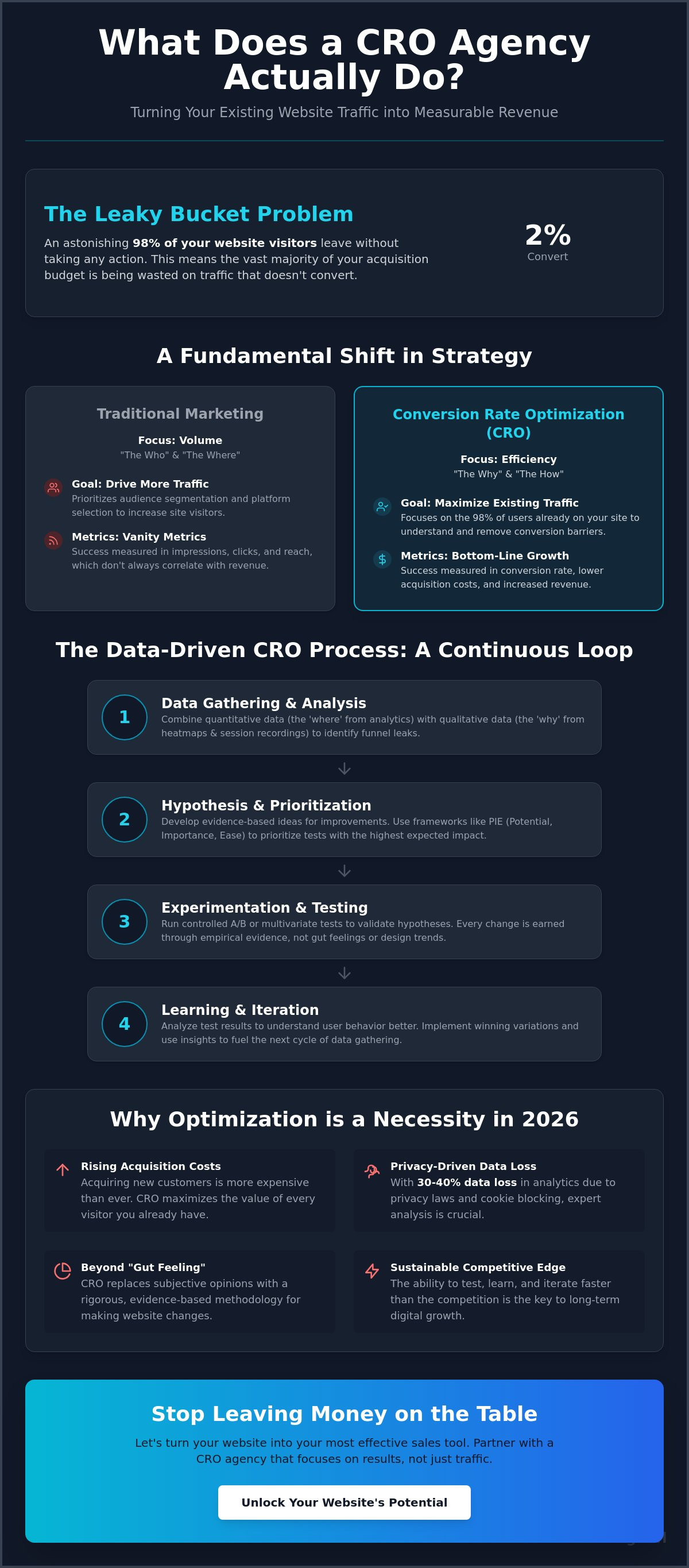
Traditional marketing agencies typically prioritize "The Who" and "The Where." They focus on audience segmentation and platform selection to drive traffic. Their success is often measured in impressions, clicks, and reach. While these metrics are necessary for growth, they don't tell the whole story. CRO specialists shift the focus to "The Why" and "The How." They investigate why a user abandons their cart or how a specific navigation structure confuses a high-intent visitor.
Acquiring new traffic is frequently the most expensive way to grow a business. In contrast, optimization focuses on the 97-98% of users who are already on your site but haven't converted. By improving the conversion rate, you lower your blended acquisition costs and increase the lifetime value of every visitor. It's a shift from a volume-based strategy to an efficiency-based one.
Rising Customer Acquisition Costs (CAC) have made optimization a survival requirement rather than a luxury. With organizations seeing 30-40% data loss in analytics due to privacy tools, businesses can't afford to make decisions based on "gut feeling" or outdated benchmarks. CRO specialists provide the methodological rigor needed for evidence-based decision-making. They ensure that your PPC management efforts aren't wasted on a landing page that fails to resonate with the user's intent. In a competitive digital landscape, the ability to test, learn, and iterate faster than the competition is the only sustainable advantage.
The CRO process is a continuous loop of observation, hypothesis, and validation. When asking what does a cro agency do, the answer lies in their ability to turn chaotic user signals into a structured roadmap for growth. They don't make changes based on aesthetic preferences or the latest design trends. Instead, they rely on a rigorous methodology that treats your website as a scientific environment where every modification must be earned through evidence. This approach is detailed in Moz's comprehensive guide to CRO, which emphasizes the need for a systematic framework to achieve repeatable success.
The process begins with a deep dive into user behavior. Analysts use Google Analytics 4 to identify exactly where the "leaks" in your funnel occur. However, quantitative data only shows the "where." To understand the "why," agencies employ qualitative tools like heatmaps and session recordings. This addresses the human element of data. By observing how users struggle with a specific form or navigation menu, specialists can apply behavioral psychology to interpret these actions. In 2026, this step is more critical than ever, as organizations are seeing 30-40% data loss in standard analytics due to increased privacy regulations and browser-level blocking.
Once the pain points are identified, the agency develops a list of potential solutions. They don't test everything at once. Instead, they use frameworks like PIE (Potential, Importance, Ease) to rank ideas based on their expected impact and technical requirements. Every test starts with a scientific hypothesis: "If we simplify the checkout form by removing non-essential fields, then the completion rate will increase by 5% because we are reducing the user's cognitive load." This ensures that every experiment aligns with your broader digital strategy objectives rather than being a random shot in the dark.
The final step involves building and launching the test variations. Whether it's an A/B test or a multivariate experiment, the goal is to reach statistical significance. This ensures that the results are a true reflection of user preference rather than a temporary fluke in traffic. Even if a test "fails" to produce a conversion lift, the analysis provides invaluable insights into your customer's mindset. These learnings are then fed back into the start of the loop to inform the next round of testing. A successful conversion strategy requires a partner who values this level of methodological transparency as much as the final results. Understanding what does a cro agency do means recognizing that their value lies in this relentless, data-backed cycle of improvement.
A strategic partner doesn't just run isolated experiments; they provide a comprehensive suite of services designed to align your website with user intent. When exploring what does a cro agency do, it's vital to recognize that their work spans technical auditing, behavioral psychology, and persuasive communication. They don't treat optimization as a siloed task. Instead, they integrate these services into your broader business objectives to ensure that every visitor interaction contributes to your bottom line. According to Forbes' guide to conversion rate optimization, this holistic approach is essential for businesses looking to scale efficiently in a crowded digital marketplace.
Technical friction is often the silent killer of conversion rates. An agency begins by identifying "where" the revenue leaks are through rigorous analytical audits. This involves more than just checking page load speeds. They scrutinize the entire lead-generation or checkout process for broken forms, confusing navigation, or elements that fail to render correctly on mobile devices. Data integrity is a priority here. With the 2026 privacy landscape causing significant data loss, specialists ensure your tracking is both compliant and accurate, providing a reliable foundation for all future testing.
Design in a CRO context is about functionality rather than just aesthetics. While a web designer might prioritize brand "feel," a CRO specialist prioritizes the user's path to completion. This service includes creating high-performance landing pages for specific ad campaigns and refining on-site elements like calls-to-action (CTAs) and value propositions. They use data to determine which headlines resonate most with your target audience, replacing generic marketing language with high-converting copy.
This focus on the user journey extends beyond your website. For example, integrating CRO with your social media marketing ensures that the messaging a user sees on LinkedIn or Instagram matches the experience they find on your site. This consistency reduces cognitive load and builds the trust necessary for a conversion. What does a cro agency do to maintain this? They constantly test messaging variations to find the precise combination of words and visuals that triggers a positive action. Typical services provided by these specialists include:
Identifying drop-off points from the initial landing page to the final thank-you screen.
Creating bespoke experiences for different traffic sources to maximize ROI.
Statistically validating every change before it becomes permanent.
Improving the interface to guide users intuitively toward the desired outcome.
By combining these services, an agency stops the "gut feeling" debates that often stall business growth. Every design choice and every line of copy is backed by user data, ensuring that your website evolves into a high-performance sales tool rather than just a digital brochure.
A common misconception in the digital sector is that a "modern" or "beautiful" website naturally translates into business revenue. While a web designer focuses on brand aesthetics and visual harmony, they often overlook the specific friction points that stop a user from converting. This is where the distinction becomes clear. If you ask what does a cro agency do differently, the answer is that they treat design as a variable to be tested, not a creative absolute. They use quantitative data to challenge assumptions that might be costing you sales. They don't just build pages; they build high-performance conversion engines.
Most website changes are driven by the "HiPPO" (Highest Paid Person’s Opinion). This reliance on gut feeling usually leads to poor conversion results because it ignores actual user behavior. For instance, testing often reveals that "ugly" or high-contrast pages outperform "beautiful," minimalist ones in specific contexts. This happens because the simpler page provides a clearer path to the goal. This is why conversion rate optimization must be treated as a separate, data-backed discipline. It moves the conversation from "I like this color" to "This color increases lead volume by 12%."
The "Big Bang" redesign is one of the riskiest moves a business can make. Industry data suggests that 50% of new websites see a drop in conversions immediately after launch. These drops occur because massive changes disrupt the user's mental model and break existing high-performing elements. A CRO agency provides a safer alternative through incremental growth. By testing individual elements continuously, you achieve low-risk improvements without the danger of a site-wide collapse. You're making decisions based on what your customers actually do, not what you think they might do.
This methodology also protects your existing performance. When you update your site through a CRO framework, you ensure that your SEO rankings and PPC quality scores remain stable. You're not guessing; you're validating every change before it becomes permanent. If you're ready to stop guessing and start growing, it's time to partner with a performance-first agency. What does a cro agency do to bridge the gap between design and development? They work alongside your technical team to implement these validated changes, ensuring that your technical foundation supports your growth objectives. This synergy ensures that every visual update serves a measurable business purpose.
Selecting a strategic partner for conversion growth is a high-stakes decision that directly impacts your bottom line. In a market where twenty US states now enforce strict privacy laws, you can't afford to hire an agency that relies on "magic" formulas or outdated tactics. When you're evaluating what does a cro agency do for your specific business, look for a firm that prioritizes transparency and methodological rigor over vague promises of overnight success. A reliable partner treats your website as a controlled environment for scientific experimentation, not a canvas for creative guesswork.
Your evaluation should start with their technical toolkit. A professional agency must demonstrate mastery over advanced analytics, heatmaps, and session recordings to decode user intent accurately. They should also possess a deep understanding of your specific industry and customer journey. A generic approach fails because the behavioral triggers for a SaaS buyer differ significantly from those of an e-commerce shopper. Finally, ensure they understand the symbiotic relationship between traffic and conversion. A partner who ignores your acquisition strategy will struggle to optimize the post-click experience effectively.
To separate high-performance agencies from surface-level service providers, ask direct questions about their methodology. Start with their approach to data integrity: "How do you handle statistical significance and sample sizes to ensure results aren't just flukes?" This is critical in 2026, where data loss from privacy tools can skew results if not handled correctly. Ask for a case study where a test failed. A transparent partner will show you what they learned from that failure and how those insights informed the next winning variation. Finally, clarify their operational workflow: "How do you integrate with our existing marketing and development teams?" A CRO agency should act as an extension of your team, not a siloed third party.
Behaviour Digital stands out by combining technical CRO expertise with a deep understanding of PPC and social ads. Based in Glasgow, our team doesn't just deliver static reports. We provide a dynamic roadmap for scalable, data-driven growth that aligns with your broader business objectives. We focus on the "Behaviour" in digital, decoding human reactions to drive specific business actions. We understand that every click represents a person with a specific intent, and our job is to remove the friction standing between that intent and your revenue.
We operate with total transparency, ensuring you understand the "why" behind every test and the "how" of every result. Our goal is to turn your existing traffic into a predictable revenue engine through continuous, methodical refinement. If you're ready to stop guessing and start making evidence-based decisions, it's time to take the next step. Book a conversion audit with Behaviour Digital today and discover exactly what does a cro agency do when they're fully committed to your long-term success.
The digital landscape of 2026 demands more than just aesthetic appeal; it requires a relentless focus on how users actually interact with your site. We've established that a successful conversion strategy replaces subjective "gut feelings" with a rigorous loop of observation and validation. By prioritizing iterative growth over risky one-off redesigns, you protect your current performance while building a scalable foundation for the future. Every change must be earned through evidence to ensure your marketing spend delivers maximum impact.
Understanding what does a cro agency do is the first step toward reclaiming the value lost to inefficient user journeys and high acquisition costs. At Behaviour Digital, our Glasgow-based expert team specializes in this exact intersection of behavioral growth and ROI. We use a proven, data-driven methodology to decode human reactions and drive measurable business action, ensuring every visitor has the highest chance of converting. We don't just provide reports; we provide a clear roadmap for your success.
Don't let your marketing budget leak through unoptimized funnels. It's time to transform your website into a high-performing sales machine with Behaviour Digital. We're ready to partner with you to turn your existing traffic into a predictable engine for revenue and long-term business growth.
Most businesses observe initial behavioral shifts within 4 to 8 weeks, but achieving statistically significant revenue growth typically requires 3 to 6 months. This timeline allows for a full cycle of data auditing, hypothesis building, and iterative testing. The speed of results depends heavily on your current traffic volume and the complexity of your conversion funnel. A methodical approach ensures that changes are based on sustained patterns rather than temporary fluctuations in user behavior.
High traffic volume accelerates the testing process, but it isn't a strict requirement for optimization. For sites with lower visitor counts, agencies pivot toward qualitative analysis, such as session recordings and user testing, to identify friction points. While A/B testing might take longer to reach statistical significance in these cases, the insights gained from behavioral analysis remain highly valuable for improving ROI. What does a cro agency do for low-traffic sites? They focus on high-impact heuristic changes that address obvious usability barriers.
Conversion rate optimization is an ongoing strategic process rather than a one-time fix. User behavior, market trends, and technological standards evolve constantly, meaning a high-performing site today will likely underperform in six months. Continuous testing ensures your digital assets remain aligned with shifting consumer intent and new privacy regulations, such as the 2026 mandates for Universal Opt-Out mechanisms. A long-term commitment allows for the compounding effect of incremental gains across the entire customer journey.
The ROI for CRO is often higher than any other marketing activity because it focuses on maximizing the value of traffic you've already paid for. Industry data shows that a 1% increase in conversion rate can potentially double business revenue without increasing acquisition costs. By plugging the "leaky bucket" in your funnel, you lower your blended customer acquisition cost (CAC). This improves the long-term profitability of your PPC and social media campaigns by ensuring more visitors reach the final checkout or lead-capture stage.
Agencies utilize a sophisticated stack of analytical and behavioral tools to decode user intent. This includes Google Analytics 4 for quantitative data and platforms like Hotjar or Microsoft Clarity for heatmaps and session recordings. In 2026, specialists also rely on AI-powered personalization engines and first-party data collection tools. These technologies are essential for bypassing the 30-40% data loss caused by modern privacy tools and browser-level blocking, providing a clearer picture of how users interact with your interface.
Yes, the same principles of behavioral psychology and data-driven testing apply to mobile applications. When evaluating what does a cro agency do in a mobile context, the focus shifts to app-specific friction points like onboarding flows, push notification timing, and in-app checkout simplicity. Optimizing these micro-interactions is essential for improving retention and lifetime value. A strategic partner ensures the mobile experience is as frictionless as the desktop version, catering to the specific constraints and behaviors of mobile users.
CRO impacts search visibility indirectly by improving user engagement metrics that search engines value. When users stay longer on your site and complete desired actions, it signals that your content is highly relevant to their intent. While the primary goal is revenue growth, the resulting reduction in bounce rates and increase in dwell time can create a positive feedback loop. This synergy ensures that your site is not only attracting visitors but also providing the high-quality experience that modern search algorithms prioritize.
A/B testing involves comparing two versions of a single variable, such as a headline or a call-to-action button, to see which performs better. Multivariate testing (MVT) is more complex; it tests multiple variables simultaneously to determine which specific combination of elements yields the highest conversion lift. MVT requires significantly more traffic to reach statistical significance but offers deeper insights into how different site elements interact. Most agencies use a mix of both depending on the specific goals and traffic constraints of the project.

Luke leads strategy across every Behaviour Digital account — building data-driven advertising systems for ambitious brands. When he's not auditing ad accounts, he's writing about what he found in them.
Get a free, tailored growth plan — we'll run our framework on your accounts and show you exactly what we'd do.
Get your free growth plan →