.webp) Online
OnlineNot sure which channel fits your business?View all services →
Three inputs. Instant KPIs. No spreadsheets.Open a calculator →
OnlineWith the cross-industry average hitting $198 in 2026, your previous marketing benchmarks are likely obsolete. Digital advertising costs have seen a steady 5% to 7% year-over-year increase, leaving many brands struggling to maintain their margins. You've probably felt the pressure of rising Meta and...

With the cross-industry average hitting $198 in 2026, your previous marketing benchmarks are likely obsolete. Digital advertising costs have seen a steady 5% to 7% year-over-year increase, leaving many brands struggling to maintain their margins. You've probably felt the pressure of rising Meta and Google costs, making it difficult to answer the board when they ask what is a good cost per lead for your specific business.
We understand that a lead's value isn't found in a low price tag but in its eventual contribution to your ROI. It's frustrating to explain fluctuations to stakeholders when the data seems to shift weekly. This guide will clarify the confusion by providing the latest 2026 industry benchmarks and the exact formula to calculate a target CPL that ensures your operations remain profitable. We'll also provide actionable steps to reduce your costs by leveraging first-party data and funnel optimization to transform your performance metrics into measurable business growth.
• Access the latest 2026 industry data to determine what is a good cost per lead for your specific sector and advertising platform.
• Learn why chasing the lowest possible CPL can damage your long-term growth and how to calculate a target based on lead-to-sale conversion rates.
• Compare the latest performance trends between Google Ads and Meta to identify where your industry's most cost-effective leads are currently found.
• Discover how to use conversion rate optimization (CRO) and behavioral segmentation to lower acquisition costs while increasing lead quality.
• Shift your focus from vanity metrics to measurable business evolution by implementing a performance-led digital strategy that prioritizes ROI.
Cost Per Lead (CPL) represents the direct financial investment required to capture a single potential customer's contact information. It's the primary performance indicator that measures the efficiency of your marketing efforts. In a market where digital advertising costs are increasing by 5% to 7% annually, CPL serves as the definitive pulse of your digital strategy. If your CPL consistently exceeds your targets, your entire growth model becomes unsustainable. Monitoring this metric allows you to pivot your budget toward the channels that provide the best value.
However, simply asking what is a good cost per lead ignores the critical factor of lead quality. A basic Lead generation campaign might produce high volumes at a low cost, but these are often just leads in the broadest sense. To build a resilient strategy, you must distinguish between Marketing Qualified Leads (MQLs) and Sales Qualified Leads (SQLs). An MQL might have only engaged with a top-of-funnel asset, whereas an SQL has demonstrated a clear intent to purchase. High-performing brands focus on the cost of the latter because cheap, unqualified leads ultimately drain sales resources and inflate your Customer Acquisition Cost (CAC).
While CPL tracks the cost of the initial interaction, CAC measures the total cost of turning that lead into a paying customer. It's possible to have a low CPL but a high CAC if your conversion rate from lead to sale is poor. Balancing these metrics is essential for long-term profitability and predictable scaling.
The calculation is simple: Total Ad Spend divided by Total Leads. For precise results, your "Total Spend" shouldn't just include the raw platform costs from Meta or Google. It must also incorporate creative production costs and agency management fees. We recommend configuring Google Analytics 4 (GA4) with specific event parameters to track these conversions accurately. Without granular tracking, you're making strategic decisions based on incomplete or misleading data.
A "good" CPL is entirely dependent on your unit economics. A standard benchmark for healthy growth is a 3:1 Lifetime Value (LTV) to CAC ratio. If your average customer is worth £10,000 over three years, you can afford a significantly higher CPL than a business with a £500 LTV. Your profit margin and sales cycle length also play critical roles. A long, complex sales cycle often justifies a higher CPL, provided the lead quality remains high. Ultimately, you must determine what is a good cost per lead by working backward from your desired profit margin per sale.
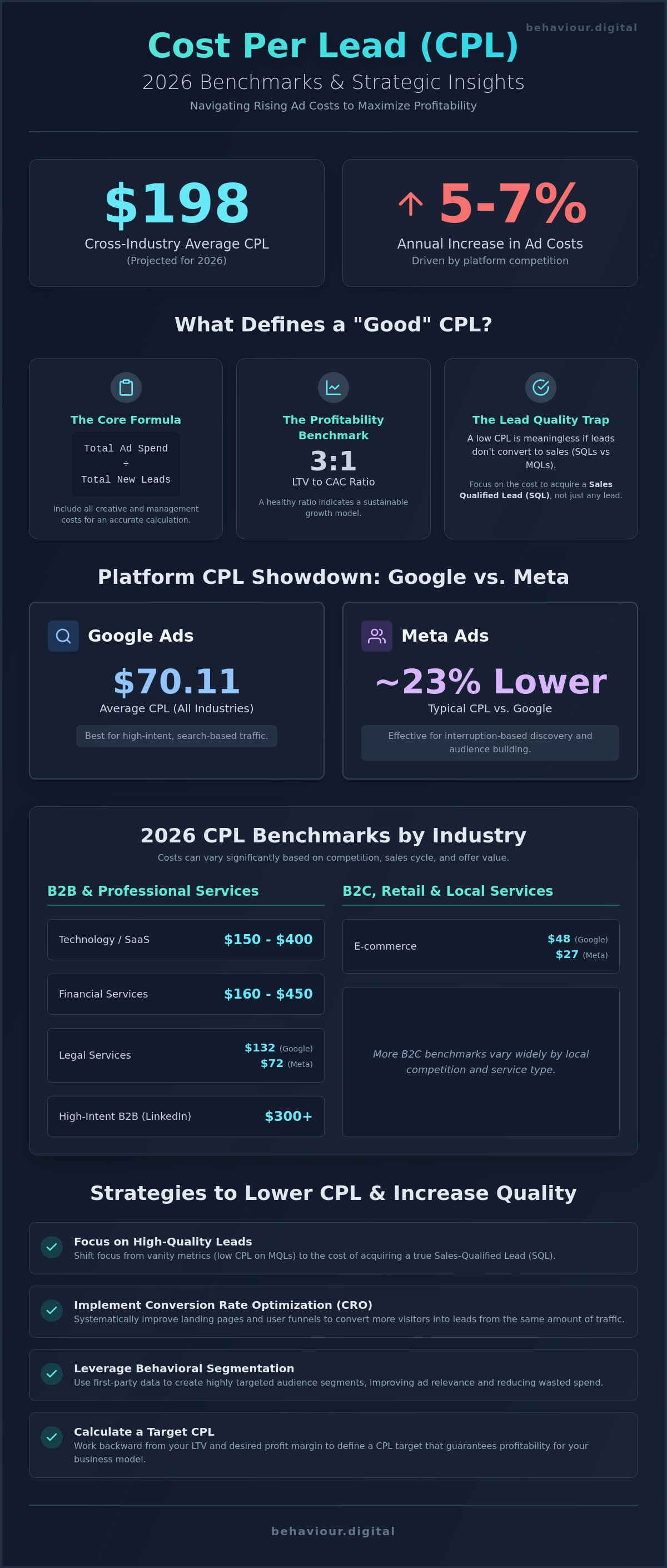
The cross-industry average cost per lead has reached approximately $198 in 2026. While this headline figure provides a broad perspective, it's often misleading for individual business planning. Digital advertising costs have risen by 5% to 7% year-over-year, driven largely by increased competition for commercial intent keywords as AI-driven search results reduce organic click-through rates. Determining what is a good cost per lead requires a granular look at your specific sector and the platforms you use to reach your audience.
Google Ads remains the benchmark for high-intent traffic, with an average CPL of $70.11 across all industries. This represents a 5% increase compared to 2024 data. Conversely, Meta Ads provide a more cost-effective entry point, with CPLs typically 23% lower than Google. This price gap exists because Meta relies on interruption-based discovery rather than active search intent. High-performing brands don't just pick the cheapest channel; they calculate a blended CPL across all touchpoints to understand the true cost of their Social Media Marketing and search efforts combined.
B2B sectors continue to see the highest acquisition costs due to long sales cycles and high contract values. In 2026, the average B2B CPL ranges between $35 and $150 for general leads, but specialized niches are significantly more expensive. Technology and SaaS companies should expect to pay between $150 and $400 per lead, while Financial Services often see costs ranging from $160 to $450. Legal services on Google Ads currently average $132, though this drops to $72 on Meta. LinkedIn remains the most expensive channel for B2B, with CPLs frequently exceeding $300 for high-intent decision-makers in cybersecurity or business insurance.
B2C benchmarks are generally lower but highly sensitive to local competition. E-commerce leads currently average $48 on Google and $27 on Meta. For local services like home repairs or healthcare, the landscape is shifting toward zero-party data leads, where users voluntarily share preferences for better personalization. Healthcare leads range from $42 to $52 on Meta, while real estate averages $100 on Google. In competitive local markets like Glasgow, bid prices for "near me" services have spiked as businesses fight for visibility in a shrinking map pack. Understanding these fluctuations is vital for calculating your true cost per lead and setting realistic expectations for your sales team. When you evaluate what is a good cost per lead, you must weigh these industry averages against your specific conversion rates and localized market conditions.
Focusing solely on minimizing acquisition costs is a common strategic error. While a low CPL might look impressive in a monthly report, it often masks a deeper issue: the influx of 'junk' leads. These are individuals with no genuine intent to purchase, often attracted by aggressive lead magnets or overly broad targeting. When your sales team spends 80% of their time chasing prospects who don't answer the phone or don't fit your buyer persona, your operational efficiency plummets. This fatigue leads to wasted resources and missed opportunities with high-value prospects.
The tension between quantity and quality is a central pillar of any robust digital strategy. To find the sweet spot, you must establish a continuous feedback loop between your marketing data and your sales results. If a specific campaign delivers a $10 CPL but zero conversions to sale, it's objectively worse than a $50 CPL campaign that closes at 20%. When stakeholders ask what is a good cost per lead, the answer must be tied to the final conversion, not the initial click.
Implementing qualification questions in your lead forms is the most effective way to filter intent. While this adds "friction" and might reduce the total number of leads, it significantly increases the value of each entry. A lead who answers three specific questions about their budget and timeline is far more valuable than one who simply entered an email for a free download. We use CRM data to trace these qualified leads back to their original ad source, allowing us to double down on the creative and targeting options that actually drive revenue rather than just volume.
Determining what is a good cost per lead for your specific business is a mathematical necessity, not a guess. You can use this fundamental framework to set your targets: (Average Order Value x Lead-to-Sale Conversion Rate) - Desired Profit Margin = Maximum Allowable CPL. For instance, if your average sale is £2,000, your close rate is 5%, and you require a £400 profit margin per customer, your maximum CPL is £80. Sharing these hard numbers with your PPC agency in Glasgow allows for a more aggressive, data-backed approach to bidding. You should also adjust these targets based on seasonal demand or market volatility to ensure your margins remain protected throughout the year.
Reducing your acquisition costs doesn't always require a larger budget; it requires a more efficient funnel. While benchmarks help you understand what is a good cost per lead for your industry, your internal focus should be on maximizing the efficiency of every click. Implementing conversion rate optimisation allows you to extract more value from your existing traffic without increasing your daily ad spend. This methodology shifts the focus from raw volume to the quality of the interaction.
Advanced audience segmentation is another critical lever. In 2026, relying on broad interests is insufficient. You must move toward behavioral intent signals, such as specific site interactions or previous engagement patterns. Combined with a consistent "Creative Refresh" schedule, this approach prevents ad fatigue on social platforms. CPLs often spike when the same audience sees the same asset more than three times, making creative diversity a financial necessity rather than an aesthetic choice.
Effective bid management in 2026 balances automated machine learning with manual strategic oversight. While Google’s automated bidding handles high-volume data well, manual overrides remain essential for low-volume, high-value B2B niches. Pruning negative keywords daily is non-negotiable to stop the financial bleed on irrelevant search terms. Additionally, your ad copy should prioritize qualifying the lead over simply generating a click. Writing for the lead means being transparent about your value proposition, which naturally filters out low-intent users before they cost you money. Advertisers who integrate first-party data via Meta's Conversions API (CAPI) are currently seeing CPLs that are 15% to 25% lower than those relying solely on pixel tracking.
Your landing page is often the weakest link in your lead generation funnel. Reducing form fields from five to three can significantly lower friction and improve conversion rates immediately. Incorporating trust signals, such as verified client reviews or industry certifications, lowers the psychological barrier to entry for new prospects. Mathematically, doubling your landing page conversion rate from 1% to 2% will effectively halve your CPL without any changes to your bidding strategy. If you want to refine these metrics and determine what is a good cost per lead for your specific margins, you can partner with us for a performance-led digital strategy that prioritizes measurable growth.
At Behaviour Digital, we view lead generation through the lens of measurable business evolution. Our Glasgow-based team operates with a performance-first mindset, combining local expertise with global execution standards. We don't settle for meeting industry benchmarks; we aim to redefine them for your specific margins. While previous sections detailed what is a good cost per lead based on 2026 data, our methodology focuses on moving your business beyond these averages. We prioritize the quantitative data that leads to sustainable scaling rather than chasing vanity metrics that look good on paper but fail to impact your bottom line.
Our process begins with a rigorous audit of your existing digital infrastructure. We identify where your budget is being diluted by poor targeting or friction-heavy landing pages. From there, we move into an aggressive scaling phase, where we optimize every touchpoint from the first ad impression to the final CRM entry. We focus heavily on "Back-End Profit" because a lead's value is only realized when it converts into revenue. By tracking the entire lifecycle of a customer, we ensure your acquisition strategy remains profitable even as platform costs fluctuate.
Success in digital marketing requires absolute transparency. We provide real-time dashboards that distill complex data into the metrics that actually matter for your growth. You'll see exactly how your investment is performing without the distraction of marketing jargon. These insights form the basis of our monthly strategic reviews, where we pivot your strategy based on emerging patterns and competitive shifts. We specialize in creating a cohesive ecosystem by integrating social media marketing management with high-intent PPC campaigns. This holistic approach ensures your brand remains visible across the entire funnel, capturing intent on search while building demand on social.
The first step toward optimizing your performance is identifying the "low-hanging fruit." During our initial audit, we often find that simple adjustments to bid management or landing page trust signals can yield immediate reductions in CPL. We don't just provide a service; we act as a strategic partner responsible for your growth. If you're ready to stop guessing what is a good cost per lead and start hitting targets that guarantee profitability, it's time for a professional assessment. Book your 2026 performance strategy session with Behaviour Digital to begin your transition from basic lead generation to data-driven business evolution.
The 2026 digital landscape requires more than just high-volume traffic. It demands a precise alignment between your acquisition costs and your back-end profitability. We've established that industry benchmarks are merely a starting point. Your true success depends on your ability to filter for high-intent leads and optimize your conversion funnel to protect your margins against rising platform costs.
Defining what is a good cost per lead for your business is a strategic necessity that must be rooted in your specific customer lifetime value. By prioritizing lead quality over raw numbers and implementing rigorous conversion rate optimization, you can maintain a competitive advantage even in the most saturated sectors.
If you're ready to move beyond generic averages, our Glasgow-based expert management team is here to help. We specialize in data-driven conversion and 2026 industry-leading ROI strategies that turn performance data into measurable business evolution. Get a Free Performance Audit from Behaviour Digital to identify the inefficiencies in your current funnel and start scaling with confidence. Success is the result of conscious strategy. Let's build yours together.
You calculate cost per lead by dividing your total marketing investment by the total number of leads generated within a specific timeframe. To get an accurate figure, your "total investment" must include your raw ad spend, creative production costs, and any external management fees. This metric allows you to compare the efficiency of different platforms and identify which channels are driving the most cost-effective growth for your business.
In 2026, a typical benchmark for B2B SaaS ranges between $150 and $400 per lead. This range is higher than many other sectors because it reflects the high lifetime value and complexity of software sales cycles. When assessing what is a good cost per lead for your SaaS model, you should focus on the cost of acquiring Sales Qualified Leads (SQLs) rather than high volumes of low-intent trial sign-ups.
Sudden spikes in CPL are often caused by increased competition for commercial keywords or platform-wide updates like Google's AI Overviews, which push paid results further down the page. Ad fatigue is another common culprit; if your creative assets haven't been refreshed, your engagement rates will drop and costs will rise. Additionally, privacy changes like the deprecation of third-party cookies have made targeting less precise, requiring higher bids to reach the same audience.
A lower CPL is not always better if it results in poor lead quality that fails to convert into revenue. Cheap leads often lack genuine purchase intent and can waste your sales team's time, ultimately increasing your total customer acquisition cost. It's often more profitable to pay a higher CPL for leads that have a higher probability of becoming long-term, high-value customers with a better ROI.
CPL measures the cost of acquiring a prospect's contact information, while CPA (Cost Per Acquisition) measures the total cost to acquire a paying customer. While CPL is a useful indicator of campaign efficiency, CPA is the definitive metric for business profitability. A low CPL combined with a high CPA suggests a bottleneck in your sales process or a significant mismatch between your marketing message and your product offering.
Landing page speed has a direct correlation with your conversion rate and your CPL. A slow-loading page increases the likelihood of users bouncing before they can complete your lead form, meaning you're paying for clicks that have zero chance of converting. By improving your page load times, you can increase your conversion rate, which naturally lowers your CPL without needing to change your bidding strategy or increase your budget.
Including agency fees is essential for understanding your true lead generation costs and protecting your profit margins. If you only account for raw ad spend, you're looking at an incomplete data set that doesn't reflect your actual operational overhead. A transparent performance strategy requires you to factor in every cost associated with the campaign to ensure your target CPL remains sustainable as you scale your marketing efforts.
In 2026, the average CPL on Google Ads is $70.11 across all industries, while Meta Ads typically offer costs that are 23% lower. Google remains the dominant platform for capturing high-intent search traffic, which often justifies its higher price point. Meta is highly effective for top-of-funnel discovery and retargeting, making it a vital component of a blended strategy. When determining what is a good cost per lead, you must weigh these platform averages against the quality of the leads they produce.

Luke leads strategy across every Behaviour Digital account — building data-driven advertising systems for ambitious brands. When he's not auditing ad accounts, he's writing about what he found in them.
Get a free, tailored growth plan — we'll run our framework on your accounts and show you exactly what we'd do.
Get your free growth plan →