.webp) Online
OnlineNot sure which channel fits your business?View all services →
Three inputs. Instant KPIs. No spreadsheets.Open a calculator →
OnlineThe median website conversion rate sits at just 2.35% as of April 2026, yet the top 10% of performers are achieving rates of 11.45% or higher. This massive performance gap proves that digital success isn't a matter of luck; it's the result of a precise, data-driven strategy. You're likely pouring bu...

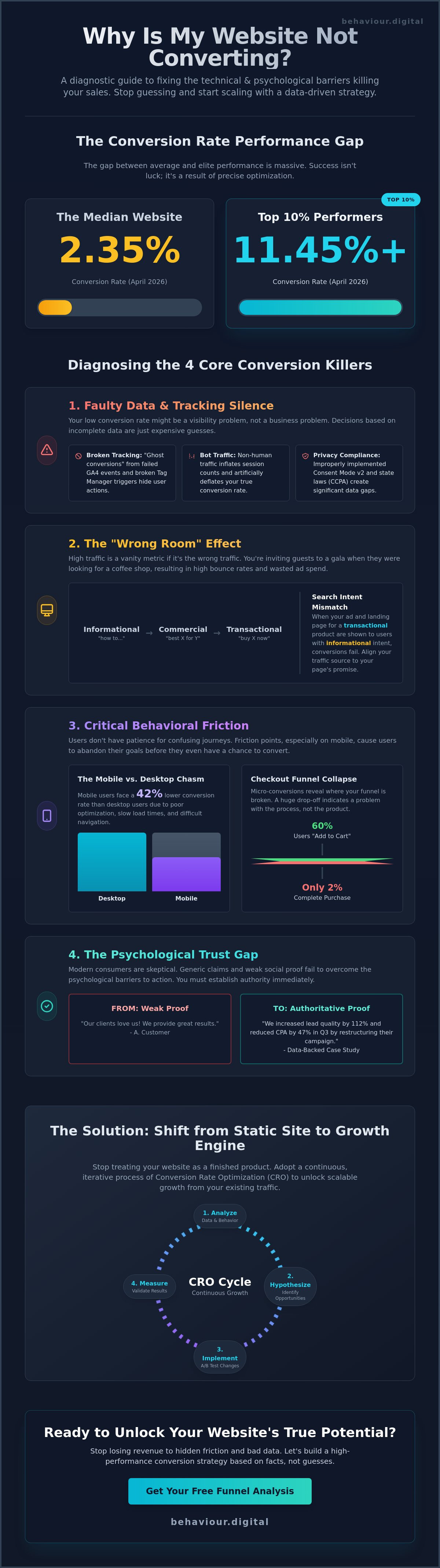
The median website conversion rate sits at just 2.35% as of April 2026, yet the top 10% of performers are achieving rates of 11.45% or higher. This massive performance gap proves that digital success isn't a matter of luck; it's the result of a precise, data-driven strategy. You're likely pouring budget into PPC and social media campaigns only to watch high bounce rates erode your ROI. It's exhausting to deal with stagnant sales while trying to decode conflicting GA4 reports. You know your traffic has potential, but you can't pinpoint the exact moment users decide to exit.
This guide will show you exactly why is my website not converting by moving beyond surface-level design and focusing on behavioral friction. We'll identify the technical and psychological barriers killing your sales. You'll gain a clear diagnostic checklist to fix your funnel and start seeing a real return on your current traffic. We'll examine the 42% conversion gap between mobile and desktop users, the impact of 2026 CCPA updates, and how Google Consent Mode v2 affects your data accuracy. It's time to stop guessing and start scaling based on facts.
• Validate your tracking integrity to eliminate "ghost conversions" and ensure your analytics reflect actual user intent.
• Diagnose why is my website not converting by identifying the "Wrong Room" effect where paid traffic expectations fail to align with landing page reality.
• Pinpoint specific behavioral friction points using heatmaps and session recordings to optimize the critical first three seconds of the mobile experience.
• Bridge the trust gap by replacing generic testimonials with data-backed case studies that establish immediate authority.
• Shift from a static website mindset to a scalable growth strategy through continuous, iterative conversion rate optimization.
Before you rewrite a single line of copy or adjust your ad spend, you must verify the integrity of your data. Many businesses lose months of growth because they solve the wrong problems. They assume their messaging is the culprit when they ask why is my website not converting; however, the reality is often a technical failure in tracking. If your analytics setup is compromised, you aren't looking at a business problem. You're looking at a visibility problem.
A conversion bottleneck is a measurable drop-off point in the user journey where potential revenue disappears. Identifying these points is the core of Conversion rate optimization (CRO). In 2026, the complexity of data collection has reached a peak. With 20 US states now enforcing comprehensive data privacy laws, your "low conversion rate" might actually be a tracking gap caused by improperly implemented consent protocols. Broken GA4 event tracking leads to "ghost conversions" where user actions occur but never reach your dashboard. Decisions based on incomplete data are not strategies; they're guesses.
Data accuracy requires proactive maintenance. A single update to your site's header can break Tag Manager triggers, leaving you blind to your most valuable traffic. Use this checklist to ensure your numbers reflect reality:
Test every primary conversion, such as form submissions, and secondary actions like newsletter signups.
If your checkout process moves from your main site to a third-party platform, ensure the session ID persists. Without this, your conversion data will show 0% attribution for your paid campaigns.
Spikes in non-human traffic can artificially deflate your conversion percentages. If your traffic doubles but engagement stays flat, check your service provider logs for bot signatures.
Focusing only on the final sale is a common strategic error. You need to track behavioral breadcrumbs to understand where the friction starts. Monitoring "Add to Cart" actions, scroll depth, or video engagement allows you to see the exact moment a user loses interest. If 60% of users add a product to their cart but only 2% reach the payment page, the problem isn't your product. It's your checkout flow. A micro-conversion is the leading indicator of macro-success. By measuring these smaller steps, you can pinpoint whether the issue is why is my website not converting or if users are simply getting stuck in a technical loop before they have the chance to buy.
High traffic volume is a vanity metric if it doesn't align with your revenue goals. When you ask why is my website not converting, the answer often lies in the source of your traffic rather than the site itself. We define this as the "Wrong Room" theory. You've effectively invited guests to a black-tie gala, but they were searching for a casual coffee shop. Irrelevant keywords might inflate your session count, but they inevitably lead to high bounce rates and wasted ad spend. Quality traffic is the foundation of any successful conversion funnel.
In competitive markets, "cheap traffic" is frequently the most expensive mistake a business can make. Low cost-per-click (CPC) often indicates low intent or poor targeting. If you're bidding on broad, generic terms without a rigorous filtering strategy, you're paying for high-velocity exits. Effective traffic management requires a partner who understands the nuances of intent-based bidding. For UK businesses looking to refine their acquisition, partnering with a specialized PPC agency Glasgow can help transform a high-volume, low-value funnel into a precision-engineered growth engine.
Understanding what visitors want on your website starts with the search query. Users have three primary intents: informational (learning), commercial (investigating), and transactional (ready to buy). "Intent leakage" occurs when your ads for transactional services appear for informational queries. Auditing your search terms report is vital. By aggressively using negative keywords, you protect your budget and ensure your landing page only serves those with the highest probability of converting. If your traffic isn't ready to buy, your site isn't failing; your targeting is.
Friction begins when the ad creative promises one thing and the landing page delivers another. If your H1 doesn't mirror the ad headline that triggered the click, the user feels a break in the "scent trail." Visual consistency is just as critical. The color palette, imagery, and brand voice must remain identical from the social feed to the final checkout. Ensuring a tight Message Match reduces the cognitive load for visitors, allowing them to focus on your value proposition rather than trying to figure out if they've landed in the right place. Stagnant traffic isn't a permanent condition; it's an optimization opportunity. If you're struggling to align your acquisition with your conversion goals, our digital strategy team can audit your funnel to ensure every click has a purpose.
Subjective opinions on aesthetics don't drive revenue. Objective behavioral data does. When you're trying to understand why is my website not converting, you must look beyond what looks "nice" and examine how users actually interact with your interface. Behavioral friction is any hurdle that slows down, confuses, or frustrates a visitor. It's the silent killer of ROI. By utilizing conversion rate optimization techniques, we move from "I think" to "I know." We identify the exact moment a user decides to leave your site and, more importantly, why they made that choice.
Speed remains the most fundamental technical friction point in 2026. Data shows that a mere 0.1-second improvement in site speed can increase retail conversion rates by 8.4%. Conversely, a one-second delay in page load time can lead to a 7% reduction in conversions. If your site takes longer than three seconds to become interactive, you've already lost the majority of your mobile audience. Technical friction also manifests in broken links, form validation errors that don't explain what went wrong, and non-responsive elements that fail to scale on modern devices. These aren't just "glitches"; they're direct hits to your bottom line.
Heatmaps provide a visual representation of user intent and frustration. We often see "Rage Clicks," where a user repeatedly clicks an element that isn't a button, indicating a UI failure. This tells us your design is misleading your visitors. Session recording audits allow us to watch the user journey in real-time. We can see if a user abandons their cart because a shipping calculator didn't load or if they struggled with a complex password requirement. This level of transparency eliminates guesswork and highlights the specific technical barriers that require immediate intervention.
The gap between mobile and desktop performance is a major opportunity for growth. Currently, mobile traffic accounts for 65% of all website traffic but converts at an average of only 1.82%, compared to 3.14% on desktop. This 42% gap is often due to poor "Thumb Zone" design. If your primary Call-to-Action (CTA) is tucked away in a corner where it's hard to reach with one hand, you're creating unnecessary friction. In 2026, mobile users expect frictionless, "One-Tap" checkout experiences. If your mobile site forces users to fill out ten fields with a tiny keyboard, you're essentially asking them to shop elsewhere. Modern mobile design isn't just about fitting content on a smaller screen; it's about adapting to the physical way people hold their devices.
Even if you've corrected your tracking and refined your traffic quality, you might still find yourself asking why is my website not converting. The answer often lies in the "Trust Gap." In 2026, users are hyper-aware of data privacy and online scams. If your site doesn't radiate authority within seconds, visitors will exit. Authority is the most undervalued conversion lever today. It's not about being "liked"; it's about being perceived as the most competent and secure solution to a specific problem.
Generic testimonials no longer move the needle. Modern consumers demand Social Proof 2.0. This involves data-backed case studies and verified user-generated content (UGC). Facts from 2026 indicate that customers who interact with reviews are 108.3% more likely to convert. Additionally, user-generated images on product pages can increase conversions by 106.3%. This is objective evidence of value that a simple quote cannot replicate. Transparency is your most powerful tool. You must be explicit about pricing, delivery timelines, and data usage to address the primary objection: is this business legitimate?
High-performing sites use "As Seen In" logos and professional certifications to anchor their credibility immediately. Your "About Us" page shouldn't be a corporate manifesto. It should humanize your brand by showing the analytical experts behind your results. Don't neglect your footer. It needs to work as hard as your header by displaying SSL certificates, secure payment icons, and clear links to your privacy policy. A well-executed UX can boost conversion rates by up to 400%, and much of that gain comes from making the user feel safe.
The "Pain of Paying" is a documented psychological hurdle. You can reduce this friction by offering clear, secure payment gateways and robust risk reversal. Guarantees, free trials, and "No-Questions-Asked" return policies shift the risk from the buyer to the seller. When a user feels they have nothing to lose, their resistance to the "Buy" button vanishes. Risk reversal removes the final barrier to conversion by providing a safety net for the skeptical visitor. If your data shows high engagement but a sudden drop-off at the payment stage, your trust signals are likely failing. Our conversion rate optimization experts can help you audit these psychological levers to turn skeptics into measurable business growth.
Scaling a business requires more than just identifying friction; it requires a systematic commitment to conversion optimisation. If you've spent weeks asking why is my website not converting, you likely realize that a "set and forget" approach is a liability. Market conditions, user behavior, and technology shift too rapidly in 2026 for a static site to remain competitive. True growth is iterative. It involves a continuous cycle of data collection, hypothesis testing, and implementation. Success is not a destination but a process of constant refinement.
Efficiency depends on the synergy between acquisition and conversion. High-intent PPC management is only half the battle. If you drive premium traffic to a page that hasn't been optimized for behavioral triggers, you're essentially burning capital. When these two disciplines work in harmony, your cost per acquisition drops while your customer lifetime value increases. You stop playing defense against high bounce rates and start playing offense with a scalable growth strategy. Data integrity makes this possible by ensuring every marketing pound is spent on traffic that actually has the potential to convert.
Efficiency in testing requires a rigorous framework. We utilize the PIE framework to prioritize experiments based on Potential, Importance, and Ease. This ensures you're testing high-impact areas like checkout flows or lead forms before moving to minor cosmetic changes. Never test more than one variable at a time. If you change the headline and the CTA button simultaneously, you won't know which element drove the result. Finally, you must reach statistical significance before declaring a winner. Making decisions based on 24 hours of data is a common trap that leads to false positives and long-term performance decay.
Deciding between DIY fixes and professional intervention is a matter of ROI. While basic technical audits can be handled internally, scaling a complex funnel requires specialized expertise. Partnering with a specialist agency like Behaviour Digital provides access to advanced behavioral analytics and a proven methodology for growth. We don't just deliver reports; we deliver measurable business impact. The cost of lost leads usually far outweighs the investment in professional CRO. Your next step should be an exhaustive audit of your current funnel to identify the "quick wins" that can fund your long-term strategy. Stop guessing why is my website not converting and start building a predictable revenue engine based on hard data.
Digital success isn't a game of chance. It's the result of precise data and behavioral alignment. You've explored how tracking errors, intent mismatches, and technical friction points quietly erode your ROI. If you've been stuck asking why is my website not converting, you now have the diagnostic framework to find the answers. Transforming stagnant traffic into a revenue engine requires moving beyond surface-level fixes. It demands a commitment to continuous, performance-led optimization.
As Glasgow PPC specialists with deep expertise in behavioral growth strategies, we provide the transparency and data-driven decision-making you need to scale. We don't just find problems; we implement measurable business solutions. Every click on your site should serve a purpose. Every visitor journey should lead toward measurable growth. Stop guessing and start growing with a professional conversion audit from Behaviour Digital. Our team is ready to help you unlock the full potential of your digital strategy. Let's turn your data into your greatest competitive advantage.
The median website conversion rate across all industries is 2.35% as of April 2026. However, the top 10% of performers achieve rates of 11.45% or higher. Benchmarks vary significantly by sector; for instance, food and beverage brands often see 4.5% to 6.0%, while luxury jewelry typically converts at 0.8% to 1.2%. Your goal should be to outperform your specific industry median through continuous optimization.
You generally need a minimum of 1,000 conversions per month to reach statistical significance within a productive timeframe. While you can run tests with lower traffic, the results often lack the mathematical certainty required for confident decision-making. If your volume is low, prioritize qualitative data like session recordings and heatmaps. This allows you to identify friction points without waiting months for a single test result to conclude.
A slow website is frequently the primary driver of high bounce rates, as a one-second delay can lead to a 7% reduction in conversions. In 2026, a 0.1-second improvement in site speed can increase retail conversion rates by 8.4%. If your site takes longer than three seconds to become interactive, you're losing visitors before they even see your value proposition. Speed is the technical foundation for all growth.
Organic search traffic typically converts at 2.7% to 3.0%, while paid social and some PPC channels can hover between 0.7% and 1.2%. This gap usually stems from search intent. Organic visitors are often actively seeking a solution, whereas ad traffic can be more exploratory. If your paid traffic isn't performing, it often points to a mismatch between the ad's promise and the landing page's reality.
You shouldn't commit to a full redesign without first using data to understand exactly why is my website not converting. Total overhauls are risky because they often remove elements that were actually performing well. An iterative approach allows you to isolate specific variables and scale based on proven wins. Systematic optimization is almost always more cost-effective and provides a more predictable path to measurable business growth.
GA4 is the essential starting point for identifying where users exit your funnel. Google PageSpeed Insights provides a clear technical roadmap for fixing load time issues, while Google Search Console helps identify intent mismatches in your traffic. For behavioral insights, the free tiers of Microsoft Clarity or Hotjar offer heatmaps and session recordings. These tools provide the transparency needed to move beyond subjective opinions and start making data-driven fixes.
Mobile traffic accounts for 65% of all web sessions, yet it converts at a rate of just 1.82% compared to 3.14% on desktop. This 42% gap proves that basic responsiveness isn't enough. You need a "behavior-first" mobile design that optimizes for the "Thumb Zone" and provides frictionless, one-tap payment options. If your mobile checkout is complex, you're asking the majority of your audience to shop elsewhere.
SEO focuses on driving traffic to your site, while CRO focuses on what that traffic does once it arrives. While we don't sell search engine optimisation, we specialize in maximizing the value of the visitors you already have. If you're still asking why is my website not converting despite having high traffic, the issue is likely a CRO problem. Our goal is to transform your current visitors into measurable business growth.

Luke leads strategy across every Behaviour Digital account — building data-driven advertising systems for ambitious brands. When he's not auditing ad accounts, he's writing about what he found in them.
Get a free, tailored growth plan — we'll run our framework on your accounts and show you exactly what we'd do.
Get your free growth plan →